
Memorial Day is a national holiday that is celebrated on the last Monday in May. It is also the unofficial start of summer (although the season really begins with the Summer Solstice in June). Most importantly, Memorial Day is a day to honor the men and women who have died while serving in the U.S. military. The origin of this holiday dates way back to the Civil War where people would go visit and decorate the gravesites of the fallen soldiers. To this day, the holiday is often celebrated by visiting cemeteries or memorials.
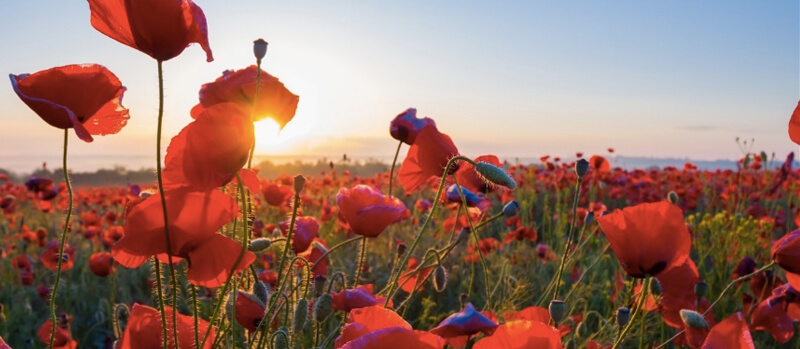
The Poppy (Papaver rhoeas, known variously as the Flanders poppy, corn poppy, red poppy, and corn rose) has become a symbol of Memorial Day. But why this humble wildflower? With its unique characteristic of remaining dormant in the earth for years, this flower has the ability to grow like small beacons of hope in the most unlikely places.
These bright red flowers were said to have been one of the first plants to grow back into the war-torn battlegrounds after World War I. In 1915, Lieutenant Colonel John McCrae, who served as a brigade surgeon for an Allied artillery unit, spotted a cluster of red poppies blooming amid the broken ground and devastation following a huge battle in which one of his closest friends, Lieutenant Alexis Helmer, was killed. Overcome with sorrow, McCrae wrote the poem “In Flanders Field,” in which he gave voice to the fallen soldiers buried under those hardy poppies.
In 1918, an American college professor named Moina Michael was so moved by the poem that she responded with a poem of her own titled “We Shall Keep the Faith.” She began a campaign to adopt the red poppy as a national symbol and started selling silk poppies to raise money for disabled soldiers. Across the sea in France, Anna Guérin was also advocating to have the poppy recognized by all Allied countries.
These resilient flowers continue to be a symbol of lives lost, as well as a symbol of recovery and new life. Poppies are worn in commemoration of those brave soldiers who lost their lives defending our country’s freedom and protecting the lives of those who could not protect themselves.
On this and every day, our gratitude goes out to those who have served, those we have lost, and to those who continue to feel the impact of the sacrifices given for our country.
May 25, 2020 by First Citizens Bank
By clicking the links above, you are now leaving First Citizens Bank's website and are going to a website that is not operated by the bank. First Citizens Bank is not responsible for the content; availability of linked sites; does not endorse or guarantee the products, information, or recommendations; and is not liable for any failure of products or services provided by the linked website. Please be advised that First Citizens Bank does not represent either the third party or you, the customer, if you enter into a transaction. Further, the privacy policy of this site owner may be different than that of the bank and this site may provide less security than the bank's website. We encourage you to read the privacy policies of websites reached through the use of links from the First Citizens Bank website.