
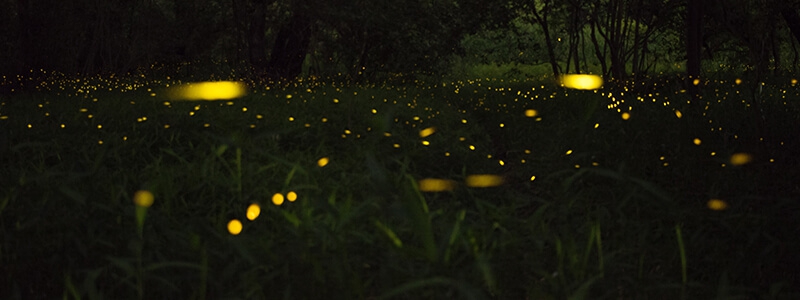
The flashes of fireflies on a warm, humid summer night remind many of us of our carefree childhood sense of wonder and delight while trying to catch them. With firefly season in full swing, their enchanting light displays often spark our curiosity and capture our imaginations. How much do you know about them?
Here are five fascinating facts about fireflies:
- Fireflies are beetles. These insects are neither flies nor true bugs. Instead they are beetles, just like ladybugs. Like other beetles, fireflies have a pair of hardened wing cases, called elytra, that the wings fold underneath. The elytra open for liftoff like gull-wing doors on a car, freeing the wings for flight. They contain a chemical in their abdomen called luciferin. When that chemical combines with oxygen and with an enzyme called luciferase, the chemical reaction causes their abdomen to light up. They regulate the flow of oxygen into their abdomen to turn their taillight on or off.
- There are more than 2,000 species of firefly worldwide. Fireflies are found all over the world, on every continent except Antarctica—and they are incredibly diverse. There can be many species sharing just one habitat. In fact, you are probably looking at multiple species when you are watching them in your own yard.
- Flashes are the firefly language of love. Fireflies use flashes as mating signals. The flashes that you see in your yard are generally from males looking for females. They flash a specific pattern while they fly, hoping for a female reply. If a female waiting in the grass or bushes likes what she sees, she responds back with a flash of her own. They will engage in this twinkling “conversation” until the male locates the female. Each species has its own pattern—a code that lets individuals identify appropriate mates of the same species. The light that fireflies produce may be green, yellow or orange in color.
- There are winter fireflies. While fireflies are largely seen as a staple of summer, there is one North American species that is active in the winter. Adults of these winter fireflies do not emit light and hide in the bark of trees, so they largely go unnoticed. Emerging to find overwintering sites in September and huddling in the furrowed bark of large trees through the winter, they find each other with pheromone signals in April and May, mate, lay eggs and are gone before their summer counterparts arrive.
- Firefly populations are threatened by light pollution. Outdoor lights prevent fireflies from seeing each other’s flashes. Thus, they have a hard time finding mates. Other potential threats include habitat loss, pesticide use, and climate change. Turn off your lights at night during firefly season to ensure you have a beautiful display for years to come.
Do you refer to them as fireflies or lightning bugs? “Enlighten” us and leave a comment on what you like to call these little creatures.
July 13, 2019 by First Citizens Bank
By clicking the links above, you are now leaving First Citizens Bank's website and are going to a website that is not operated by the bank. First Citizens Bank is not responsible for the content; availability of linked sites; does not endorse or guarantee the products, information, or recommendations; and is not liable for any failure of products or services provided by the linked website. Please be advised that First Citizens Bank does not represent either the third party or you, the customer, if you enter into a transaction. Further, the privacy policy of this site owner may be different than that of the bank and this site may provide less security than the bank's website. We encourage you to read the privacy policies of websites reached through the use of links from the First Citizens Bank website.